A new analysis finds that women are far more likely than men to face financial hardship in retirement. Women are 80 percent more likely than men to be impoverished at age 65 and older.
Shortchanged in Retirement, The Continuing Challenges to Women’s Financial Future, finds that across all age groups, women have substantially less income in retirement than men.
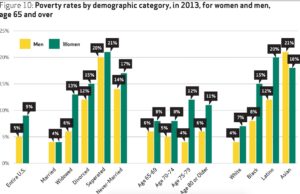
For women age 65 and older, the data indicate that their typical income is 25 percent lower than men. As men and women age, men’s income advantage widens to 44 percent by age 80 and older. Consequently, women were 80 percent more likely than men to be impoverished at age 65 and older, while women age 75 to 79 were three times more likely to fall below the poverty level as compared to their males counterparts. The report also finds that in 2010, men received $17,856 in median retirement income from a pension, whereas women received $12,000—or 33 percent less.
There is also a gender gap in defined contribution or 401(k)-type retirement account assets. In 2014, the median amount accumulated in these savings accounts was $36,875 for men and $24,446 for women—or 34 percent less, according to Vanguard.
The key findings of this report are as follows:
- Women are 80 percent more likely than men to be impoverished at age 65 and older, while women between the ages of 75 to 79 are three times more likely than men to be living in poverty. Widowed women are twice as likely to be living in poverty than their male counterparts. White and black women are almost twice as likely to be living in poverty than their male counterparts during retirement.
- Labor force participation among women aged 55 to 64 climbed from 53 percent in 2000, to 59 percent in 2015, with a peak of 61 percent in 2010. Women may be working longer in order to make up for lower retirement savings over their careers and to offset investment losses from the Great Recession.
- While women were somewhat more likely than men to work for employers that offered retirement plans in 2012, there is a gap in eligibility that limits women’s participation in these plans. Since 2006, this gap has narrowed and now women and men have the same overall participation rates. Women’s higher rates of part-time employment and shorter job tenure may make it more difficult to meet employers’ eligibility requirements for retirement plans compared to men.
- The share of women working for employers that offered only defined contribution (DC) retirement plans shrank from 49 percent in 2009 to 46 percent in 2012. The median value in women’s DC retirement accounts was one-third less than that of men.
- Even though the median household incomes of individuals aged 65 and older has increased, women have 26 percent less income than men. While both women and men have decreased their reliance on Social Security since 2009, the proportion of income from defined benefit (DB) pensions has remained steady, supplying about one-fifth of income for both women and men. Older men and women have increased their reliance upon earnings since 2009.
- Social Security is an important source of income for older households with incomes less than $80,000. Women who are widowed, divorced, and over age 70 rely on Social Security benefits for a majority of their income. Black women rely largely on Social Security, while women of other ethnic groups also rely on wages to a large extent.
- Women in the health care, education, and public administration fields, where DB pension plans are more prevalent, have higher incomes in retirement and lower rates of poverty than in other industries, due to their increased participation in DB pension plans.
In addition to spotlighting the gender disparities, the report details public policy options that can help that reduce women’s vulnerability to financial hardship as they age. These proposals to strengthen retirement security for women include:
- Strengthening Social Security benefits for women.
- Increasing retirement plan coverage through auto enrollment in individual retirement accounts (auto-IRA).
- Expanding utilization of the Saver’s Credit. Increased development of state-sponsored savings plans.
- Increasing defined contribution plan eligibility for part-time workers.
- Providing spousal protections in defined contribution accounts.
- Expanding defined benefit pension plans.
This report is based on the authors’ analysis of the 2012 Survey of Income and Program Participation (SIPP) data from the United States Census. It examines the distinct challenges posed by the current retirement system of Social Security, pensions, and savings for working-age women, retirement-aged women, and retired women. Report authors include Jennifer Erin Brown, NIRS manager of research; Nari Rhee, manager of the Retirement Security Program at the Institute for Research on Labor and Employment/Center for Labor Research and Education at the University of California at Berkeley; Joelle Saad-Lessler, recently with the New School for Social Research; and Diane Oakley NIRS executive director. A grant from BNY Mellon Investment helped make this report possible.
- Read the press release here.
- Download the PowerPoint here.