Debunking the Job-Hopping Myth: A Data-Driven Look at Tenure and Turnover Among Younger Workers
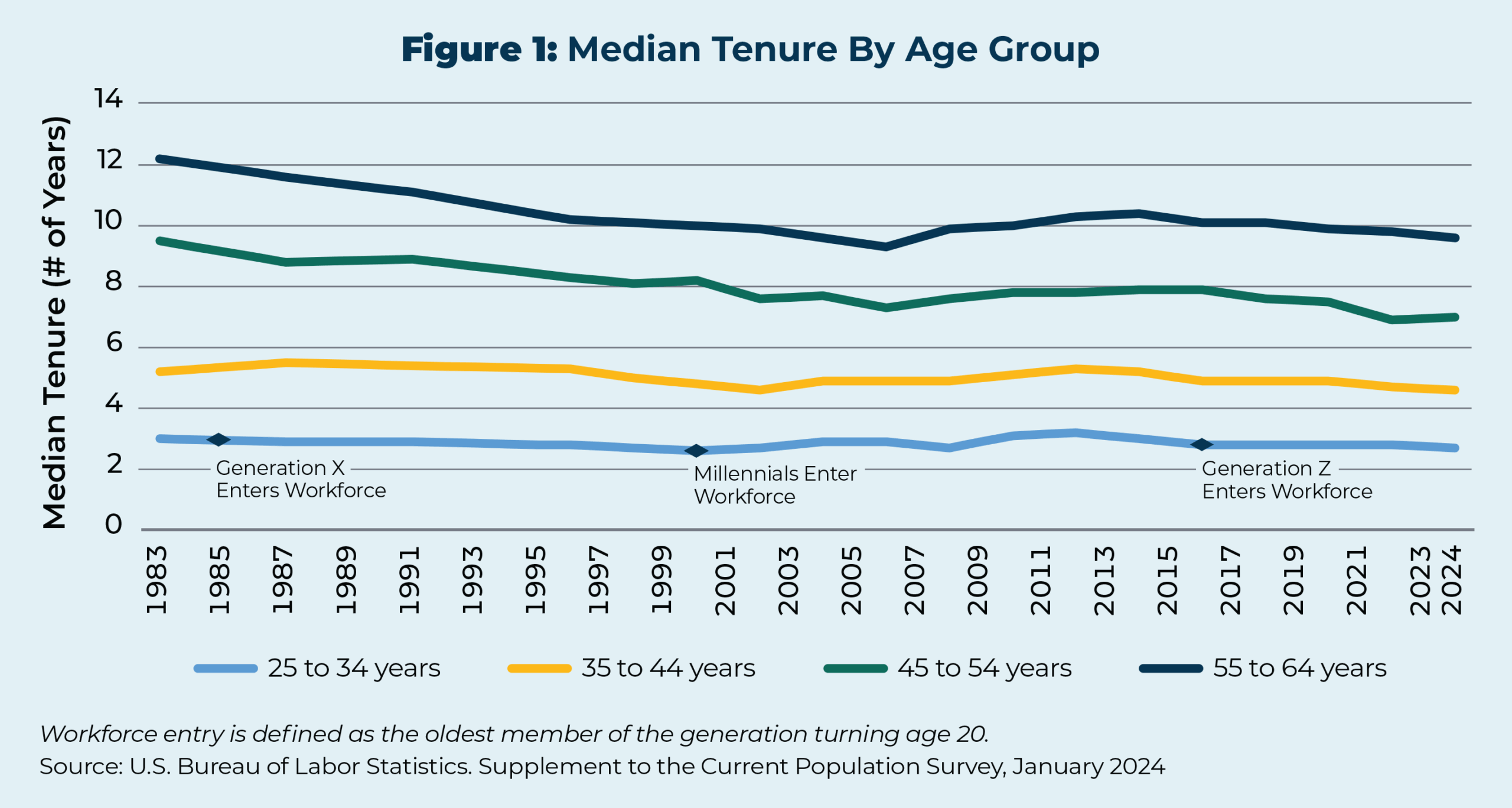
A common narrative about Millennials and Generation Z workers is that they frequently switch jobs. However, research finds that younger workers today show job retention patterns that closely mirror previous generations at the same stage of their careers.
Debunking the Job-Hopping Myth: A Data-Driven Look at Tenure and Turnover Among Younger Workers uses decades of U.S. Bureau of Labor Statistics data and additional independent research to examine employee tenure across generations.
The research finds:
Median job tenure is nearly identical across generations. Workers aged 25–34 in 2024 (Millennials and Gen Z) had a median tenure of 2.7 years, only slightly lower than Baby Boomers at the same age in 1983.
Economic conditions, rather than generational attitudes, drive worker turnover. Quit rates rise during strong economies and fall during recessions, as seen during the 2008 Great Recession and the 2020 pandemic.
Public sector benefits promote retention. State and local government employees have significantly lower quit rates due to more widespread access to pensions and healthcare benefits.
Industry differences shape job stability. Manufacturing jobs, which traditionally offer stronger benefits, show higher retention rates compared to retail and professional services.
Retirement in America: An Analysis of Retirement Preparedness Among Working-Age Americans
Retirement in America: An Analysis of Retirement Preparedness Among Working-Age Americans answers key questions relating to retirement savings, access to retirement plans, and how saving for retirement interacts with other financial commitments, such as repaying student loan debt and owning a home. It offers a broad examination of how different groups of workers are faring in their preparation for retirement and where workers are falling short.
What Do Americans Think About Pensions For Public Employees?
A research infographic from the National Institute on Retirement Security (NIRS) finds strong support among Americans for retirement benefits provided to state and local government employees. “What Do Americans Think About Pensions For Public Employees? finds 86 percent of Americans say all workers, not just those employed by state and local governments, should have a […]
Views of Retirement in America by Political Party Affiliation
Despite deep polarization across the U.S., a research brief from the National Institute on Retirement Security finds common ground when it comes to Americans’ support for Social Security and defined benefit pension plans. At the same time, Views of Retirement in America by Political Party Affiliation finds Americans across party lines are worried about retirement. […]
The Role of Defined Benefit Pensions in Recruiting and Retaining Public Safety Professionals
As state and local governments across the nation continue to struggle filling public safety positions, new research from the National Institute on Retirement Security (NIRS) explores how defined benefit pension plans are a critical workforce management tool for public safety employers. The Role of Defined Benefit Pensions in Recruiting and Retaining Public Safety Professionals examines data from a nationally representative sample of 28 police and fire pension plans, as well as national datasets.