Out of Balance? Comparing Public and Private Sector Compensation over 20 Years
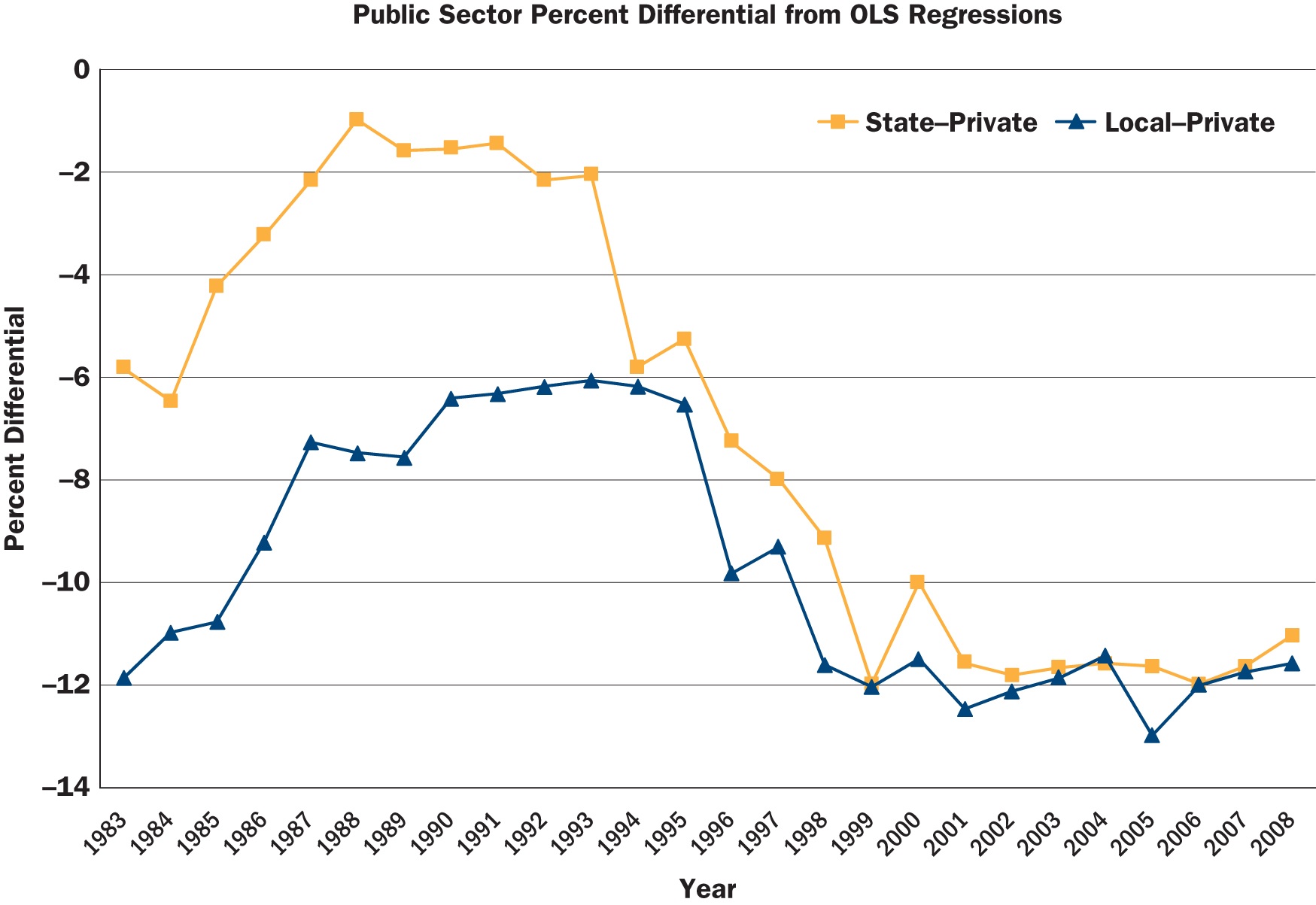
Employees of state & local government earn an average of 11% and 12% less, respectively, than comparable private sector employees. An analysis spanning two decades shows the pay gap between public and private sector employees has widened in recent years.
Jobs in the public sector typically require more education than private sector positions. Thus, state and local employees are twice as likely to hold a college degree or higher as compared to private sector employees. Only 23% of private sector employees have completed college as compared to about 48% in the public sector.
Wages and salaries of state and local employees are lower than those for private sector employees with comparable earnings determinants such as education and work experience. State workers typically earn 11% less and local workers 12% less.
During the last 15 years, the pay gap has grown – earnings for state and local workers have generally declined relative to comparable private sector employees.
The pattern of declining relative earnings remains true in most of the large states examined in the study, although there does exist some state level variation.
Benefits make up a slightly larger share of compensation for the state and local sector. But even after accounting for the value of retirement, healthcare, and other benefits, state and local employees earn less than private sector counterparts. On average, total compensation is 6.8% lower for state employees and 7.4% lower for local employees than for comparable private sector employees.
Out of Balance also estimates the variation of these trends across some of the largest states – California, Florida, Illinois, Michigan, New York, Pennsylvania, and Texas:
Florida’s Property Tax Initiative and the Unexpected Connection to Retirement Security
Property-tax relief could help homeowners facing rising costs—but what could it mean for the services they rely on and the retirement benefits of the public employees who provide them?
Recorded before a live audience at the Florida Public Pension Trustees Association conference, this Special Edition of Retirement in America examines Florida’s proposed property-tax changes, known as Amendment 3. The conversation looks beyond next year’s tax bill to consider how reduced revenues could affect staffing, emergency response, infrastructure, local control and public pension funding over time.
Watch this Special Edition Episode, Florida’s Property Tax Initiative and the Unexpected Connection to Retirement Security, below.
Workforce Turnover and Retention in the Public Sector: Insights from Public Pension Plans
This report examines how retention changes over public employees’ careers and varies across public workforces and retirement systems. The analysis draws on actuarial turnover assumptions and other information collected from 136 state-administered public pension plans representing 203 plan-employee groups and 12.8 million active members.